
To do a fire resistance analysis based on a fire-resistant coating (like intumescent paints), proceed as follows:
- Draw the structure.
- Apply a fire-resistant paint to the desired bars (if relevant)
 .
. - Add a load group for fire
 .
. - Assign the desired fire curve to the bars.
- Generate the fire combinations ULS FI
 .
. - Calculate the thermal response
 .
. - Do an elastic analysis
 .
. - Do the steel verification
 .
. - Optimize the paint thickness for protected and unprotected bars
 .
.
The content of two tab pages is discussed in the next paragraphs.
More information on fire design in general can be found in this article.
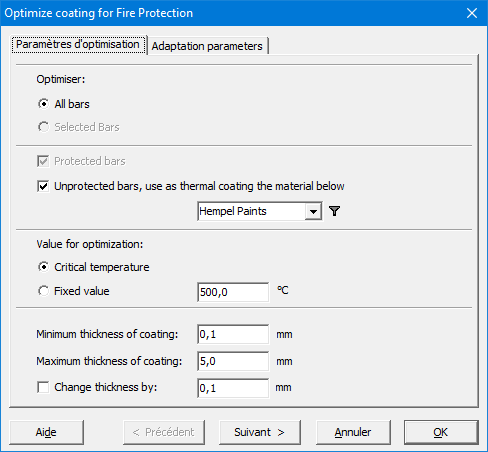

- Tab page “Optimization parameter
- Optimize all bars or only the selected bars.
- The optimization will default run on the protected bars.
Select if you also want to apply a thermal coating on the unprotected bars. In that case, selected the relevant thermal coating. - Indicate if the thickness of the thermal coating should be optimized to the critical temperature or a user defined value (specify the value).
- The critical temperature is the temperature at which the steel verification reaches 100% for a unprotected bar.
- Indicate an interval for the minimum and maximum thickness of the thermal coating.
- Keep in mind that most fire-resistant paints have a minimum and maximum thickness due to practical reasons.
- Set the step to increase the coating thickness by a certain step.
- Tab page “Adaptation parameters”
- Choose if Diamonds should adapt the profiles automatically after the optimization or show a summary in which you can select the profiles that should be adapted.
- Specify the rules for adapting the sections.