
1•2•Build can generate wind loads on canopy roofs and buildings.
- A canopy roof is a structure with maximum one facade (like a gas station)
- A building is a structure with facades (with openings like doors, windows and optionally gates).
It goes without saying that the wind loads for canopy roofs and buildings are not the same.
When you open the wind generator  and click on the button ‘Internal pressures’ makes the following dialog show up:
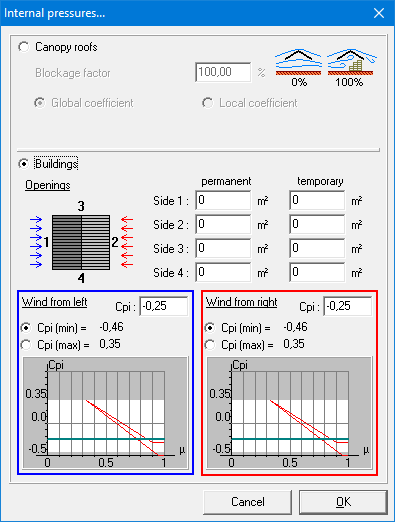
- The upper half of this dialog is used determine the wind loads on canopy roofs. The magnitude of the wind loads is influenced by the blockage.
- φ=0% if the space below the canopy roof remains free
- φ=100% if obstacles below the canopy roof prevent the wind from passing
Furthermore, a distinction is made between a global and a local coefficient. The global coefficient is used to estimate the global strength/stability of the structure. The local pressure coefficient is used for design and calculation of roof coverings and fasteners.
- To calculate the wind loads on buildings, you need two pressure coefficients:
- The external pressure coefficient cpe depends on the shape and dimensions of the structure (the outer shell). 1•2•Build determines these pressure coefficients automatically based on the selected shape.The internal pressure coefficient cpi depends on the permanent and temporary openings in the structure. The lower part of this dialog is used to determine the internal pressure coefficients cpi for buildings.
- Since 1•2•Build considers two wind directions, there are also two internal pressure coefficients. The one for wind from left to right is in the blue rectangle and the one for wind from right to left in the red one.
- Both rectangles contain a graph showing the range within which the internal pressure coefficient can vary.
- Or you enter the area of the openings on each side. Then 1•2•Build will automatically calculate which internal pressure coefficient you should use.
- Or you opt for the lower or upper bound by selecting respectively cpi.min or cpi.max.
- Or you manually enter a value for the internal pressure coefficient.