
Concrete parameters
Based on the concrete quality you have selected, 1•2•Build determines the corresponding properties that are used in the reinforcement calculation. Although you, as the user, cannot manually set all the parameters described below, they are of course included in the calculation note for concrete elements.
- The characteristic compressive strength of the concrete fck at an age of 28 days. 1•2•Build will apply a safety factor of 1.5 to this, in accordance with Eurocode.
- The modulus of elasticity of the concrete Ec,28 at an age of 28 days.
1•2•Build sets this standard to the secant modulus of the concrete and calculates it automatically based on the characteristic compressive strength of the concrete fck. This is included in the calculation of the concrete stresses. - The creep coefficient φ(t,t0)
1•2•Build determines the creep coefficient in such a way that the ratio between the modulus of elasticity of steel Es (200000 N/mm²) and that of concrete after creep Ec (=Ec,28/(1+φ)) is equal to 15.
The creep factor in 1•2•Build only intervenes in the calculation of concrete stresses. 1•2•Build limits the concrete stress in a BGT ZC combination to 0.6∙fck and in a BGT QP combination to 0.45∙fck, in accordance with Eurocode.
The creep factor in 1•2•Build is NOT used to calculate any cracked deflections with/without creep. This is not possible in 1•2•Build. 1•2•Build only shows the elastic deformations. - Finally, if necessary, 1•2•Build will increase the reinforcement to solve any buckling problems. The buckling is verified using the method based on the nominal curvature (EN 1992-1-1 §5.8.8). This method requires a random eccentricity that takes into account a possible skew. 1•2•Build sets the accidental eccentricity equal to 20 mm.
Reinforcement parameters
Based on the yield strength fyk you have selected for the reinforcing steel and reinforcement cover, 1•2•Build determines the corresponding properties that are used in the reinforcement calculation. Although you, as the user, cannot manually set all the parameters described below, they are of course included in the calculation note for concrete elements.
- 1•2•Build uses the yield strength fyk for both longitudinal and transverse reinforcement (stirrups).
- 1•2•Build applies a safety factor of 1.15 to the yield strength fyk, in accordance with Eurocode.
- Reinforcement cover is defined as the distance from the centre of gravity of the reinforcement to the edge of the concrete cross-section.
- If a certain amount of reinforcement is required for the force to be exerted, this is increased to the minimum reinforcement percentage (0.15%) if necessary.
- If the maximum reinforcement percentage is exceeded, 1•2•Build displays a skull and crossbones in the relevant elements.
- 1•2•Build limits the steel stress in a BGT ZC combination to 0.8∙fyk in accordance with Eurocode.
Calculation
For the theoretical background of the reinforcement calculation, we refer to Eurocode 2 and to Part 3 of this reference manual on calculating in accordance with the Eurocodes (only available in Dutch or French).
Below is an example of the bottom and top reinforcement for a simple beam.
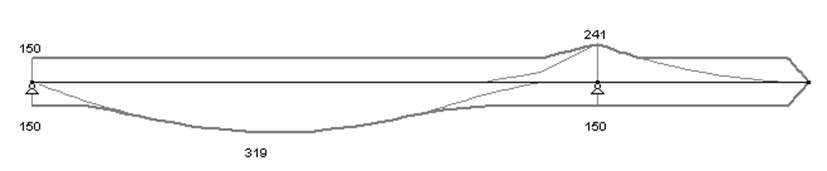
The thin line represents the amount of reinforcement required to meet only the ultimate limit state. The thicker line represents these amounts increased to take into account the limitation of stresses in the serviceability limit states, while respecting minimum reinforcement percentages and any risk of buckling.