
Description

| Geometry | Cross-section: |   |
|---|---|---|
| Column height: Buckling length: |
  |
|
| Material: | C25/30 | |
| Concrete cover: |  |
|
Creep factor  : : |
2 | |
| Reinforcement distribution: | Identical Only upper and lower |
|
| Load | Design forces: |    |
| Standard | EN 1992-1-1:2005 [- -] |
Diamonds looks for the most economical reinforcement ratio between Az and Ay by default. This is does not always results in a calculation along the local y’- axis or one along the local z’-axis. When loads (and/or eccentricities) are present along the y’- and z’ axis, the calculation is done around the resulting axes of the loads/eccentricities. Because this calculation is no longer in one specific plane, it becames hard to recalculate by hand. In this example, we’ll do some adjustments to the model, so that the calculation is in one particular plane parallel to one the local axes and can be reproduced by hand calculations.
- choose only top and bottom reinforcement and set the reinforcement distribution to ‘identical’.
This way, you ask Diamonds to calculate equal reinforcements amounts for the top and bottom reinforcement. This is a reinforcement distribution for which graphs/tables are available in literature so we can do a hand calculation.

- In this example we want to focus on the 2nd order effects. Therefor we set the accidental eccentricity to zero.
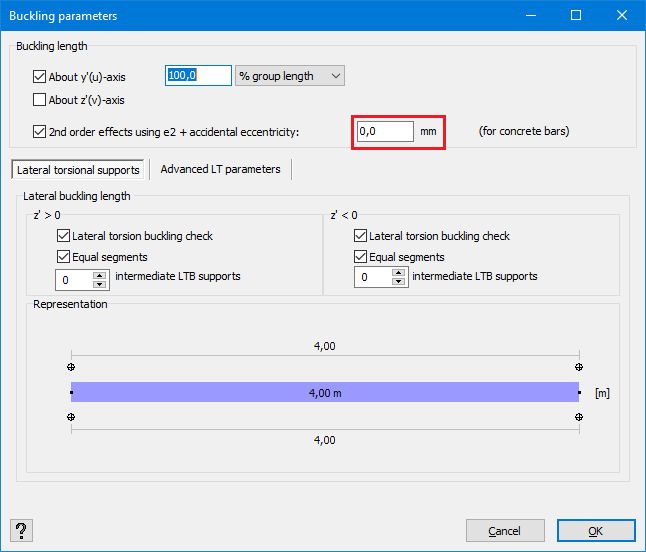
- By default, Diamonds will apply the 2nd order eccentricity in different directions. Since the cross section is not a square, and the loads are applied around the strong axis, we can already predict that the worst direction for the 2nd order effect, will be around the weak axis. When that happens, the loads no longer act in one particular plane.
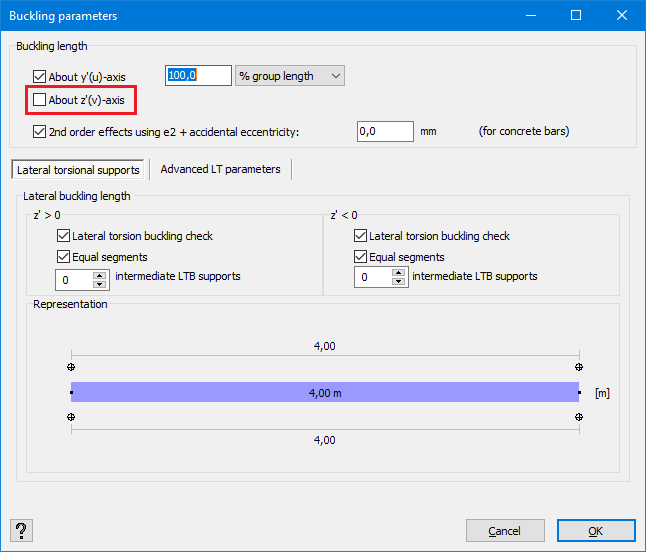
So to force Diamonds into applying the 2nd order effect into the same direction as the already present bending moment, we deselect the buckling verification around the weak axis.
- According to Eurocode 2, reinforcement is required for the forces in ULS, possibly increased with additional reinforcement to limit the stresses in SLS. We don’t know in advance whether additional reinforcement will be required for SLS. Since we are only doing a ULS calculation in this example, we turn off the stress limits in SLS in Diamonds (by making a copy of C25/30 and editing the copy).


Independent reference results
Is a 2nd order calculation required? (EN 1992-1-1 §5.8.3.1)
This column has the same ULS loads has validation example DC EC 05. So we just reuse the reinforcement amounts:
![\[A_s=2 \cdot 514mm^2=1028mm^2\]](https://support.buildsoft.eu/wp-content/ql-cache/quicklatex.com-af84167972979ecb9c9688a476e0021a_l3.png "Rendered by QuickLaTeX.com")
![\[A_c=A - As = 250mm \cdot 400 mm - 1028mm^2= 98972mm^2\]](https://support.buildsoft.eu/wp-content/ql-cache/quicklatex.com-f5c4831389222f0b59cfb431ae9dc79e_l3.png "Rendered by QuickLaTeX.com")
![\[I_{0.c}=\frac{b \cdot h^3}{12}=\frac{250mm \cdot (400m)^3}{12}=133333cm^4\]](https://support.buildsoft.eu/wp-content/ql-cache/quicklatex.com-658f5b729247e20af353c36ee4edd359_l3.png "Rendered by QuickLaTeX.com")
(5.14) 
![\[n=\frac{N_{Ed.ULS}}{A \cdot f_{cd}} = \frac{300\text{kN}}{100000mm^2 \cdot 16.67\text{MPa}}=0.18\]](https://support.buildsoft.eu/wp-content/ql-cache/quicklatex.com-96459d95d4bfdd11d1c2d1aba0f57d59_l3.png "Rendered by QuickLaTeX.com")
![\[A=1.7; B=1.1; C=0.7\]](https://support.buildsoft.eu/wp-content/ql-cache/quicklatex.com-60a924916ba1498ad4e85c95175ef92b_l3.png "Rendered by QuickLaTeX.com")
(5.13N) 
Because  is bigger than
  , second order effects need to be taken into account.
Magnitude of 2nd order eccentricity (EN 1992-1-1 §5.8.3.2)
![\[n_u=1+\frac{A_s \cdot f_{yd}}{A_c \cdot f_{cd}}=1+\frac{1028mm^2 \cdot 434.7\text{MPa}}{98972mm^2 \cdot 16.6\text{MPa}}=1.27\]](https://support.buildsoft.eu/wp-content/ql-cache/quicklatex.com-c5730b0e2204f066bff8f6d716a3c944_l3.png "Rendered by QuickLaTeX.com")
![\[n_{bal}=0.4\]](https://support.buildsoft.eu/wp-content/ql-cache/quicklatex.com-de318785dff12e41855f535d2c95bd63_l3.png "Rendered by QuickLaTeX.com")
Correction factor
 depending on the axial force (this factor is called
  in ENV):
 (5.36) 
![\[\beta =0.35+\frac{f_{ck}}{200\text{MPa}}-\frac{\lambda }{150} = 0.35+\frac{25\text{MPa}}{200\text{MPa}}-\frac{34.64}{150} = 0.244\]](https://support.buildsoft.eu/wp-content/ql-cache/quicklatex.com-d4a677f3ddd550ba98c629759481cc88_l3.png "Rendered by QuickLaTeX.com")
(5.19) 
Correction factor
 depending on the creep coefficient (this factor is called
  in ENV):
 (5.37) 
![\[c=8 \qquad \qquad \text{because constant bending moment, see EN 1992-1-1 §5.8.8.2 (4)}\]](https://support.buildsoft.eu/wp-content/ql-cache/quicklatex.com-17f1ee96c4ca1591581b64eb9fa8ac8c_l3.png "Rendered by QuickLaTeX.com")
The radius of curvature:
(5.34) 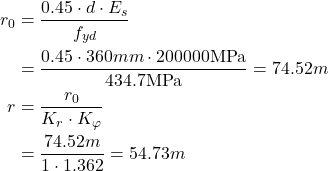
The second order excentricity:
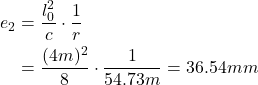
Magnitude of design bending moment (2nd order effect included)
The additional moment for 2nd order effects equals:
(5.33) 
The total design moment becomes:
![\[M_{Ed}= M_{Ed.ULS} + M_{Ed.2nd.order} = 120\text{kN} \cdot 11 \text{kNm} = 131.0 \text{kNm}\]](https://support.buildsoft.eu/wp-content/ql-cache/quicklatex.com-d6c467031df0e46f795e5a947d5113c3_l3.png "Rendered by QuickLaTeX.com")
Reinforcement calculation
The principle for calculating the longitudinal reinfordement is entirly the same as in validation example DC EC 05. Only  differs:
![\[\mu_d=\frac{M_{Ed}}{b\cdot d^2 \cdot f_{cd}}=\frac{131\text{kNm}}{250mm\cdot (360mm)^2\cdot 16.6\text{MPa}}=0.243 \]](https://support.buildsoft.eu/wp-content/ql-cache/quicklatex.com-a66f7c8687cff5773bc5a36b89bf5e86_l3.png "Rendered by QuickLaTeX.com")
Graph 10.2a from Gewapend beton: numeri (click here to open the graph) shows  as a function of
  and
and  . Using this graph and the results above, we can deduct:
![\[\omega _1=\omega _2=0.172\]](https://support.buildsoft.eu/wp-content/ql-cache/quicklatex.com-d793a4380f5a0a732d8b84c744fc2c45_l3.png "Rendered by QuickLaTeX.com")
![\[A_{s1}=A_{s2}=\omega_1 \cdot b \cdot d\cdot \frac{f_{cd}}{f_{yd}}= 0.172 \cdot 250mm \cdot 360mm \cdot \frac{16.6\text{MPa}}{434.8\text{MPa}} = 593mm^2\]](https://support.buildsoft.eu/wp-content/ql-cache/quicklatex.com-69d0b67a436cfcec5fb82bbbf25201ba_l3.png "Rendered by QuickLaTeX.com")
Diamonds results and comparison

Longitudinal reinforcement calculated by Diamonds (EN 1992-1-1 [- -])
The reinforcement due to ULS is shown using a thin line, the reinforcement due to ULS + SLS + buckling with a thick line. Because the SLS verification were turned off, the thick line represents the reinforcement for ULS + buckling.
| Results | Independent reference | Diamonds | Difference |
|---|---|---|---|
| Longitudinal reinforcement | 593mm² | 593mm² | 0% |
Remarks and notes:
- Don’t forget the calculate the buckling lengths or impose them manually.
- In the calculation of
 , Diamonds uses
  instead of
  . This is because at the moment he starts his calculations, the longitudinal reinforcement
  has not yet been unambiguously determined.
References
- EN 1992-1-1: 2005 + AC: 2010
- Van Hooymissen, L., Spegelaere, M., Van Gysel, A., & De Vylder, W. (2002). Gewapend beton. Academia Press
Keep in mind that the calculations in this book are made using the NBN B15-002/ ENV 1992-1. Both old standards.
However, this book still remains a good reference if you want to understand how reinforcement calculations work. - Gruyaert, E., & Minne, P. (2019). Gewapend beton: numeri.
This reference is a summary of Gewapend beton (2002) but with updated formula and principles according to EN 1992-1-1. This document contains multiple graphs and tables helping the design of reinforced concrete.
- Tested in Diamonds 2026.