
Yes, Diamonds can do a design for cold formed cross-sections on the condition the relevant parameters are available. In the article below, we’ll discuss which parameters you need.
Regular versus thin-walled cross-sections
Eurocode makes a distinction between:
- Regular steel cross-sections who can have the production methods: hot rolled, welded or cold formed
These cross-sections have a thickness t >= 3mm and are designed using EN 1993-1-1. - Thin walled steel cross-section who have the production method: cold-formed
These cross-sections have a thickness t < 3mm and are designed using EN 1993-1-3.
Diamonds contains a library of common thin walled cross-sections (MRP, Brause, Joris Ide, Sadef). For those sections, Diamonds will automatically apply EN 1993-1-3.
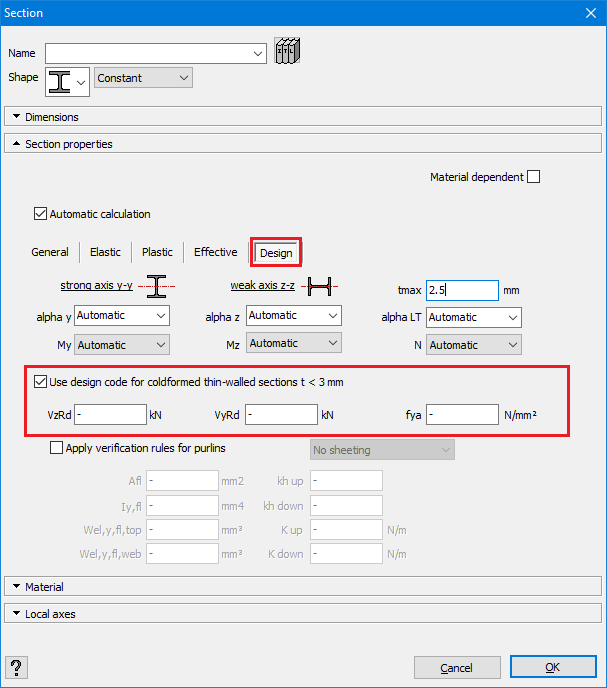
Any other type of cross-section is default calculated according to EN 1993-1-1. However, if the thickness < 3mm and the production method is defined as ‘cold formed’, you can impose Diamonds to use EN 1993-1-3 by checking this option. The parameters VzRd, VyRd and fya required for the design, need to be imposed by the user.
Effective properties
Eurocode organizes cross-sections into four classes that describe the behaviour of that cross-section.
- Class 1 & 2 are plastic cross-sections
- Class 3 are elastic cross-sections
- And Class 4 are slender cross-sections.
For classes 1 to 3, it’s easy to determine the section properties required to do a design according to EN 1993. Class 4 on the other hand, requires effectieve properties to do a design according to EN 1993… which are much harder to determine.
‘Regular’ steel cross-sections can be of class 1 to 4. Thin walled cross-sections are almost always of class 4.
The table below gives an overview for which cross-sections Diamonds has these effective properties.
| Parameters for elastic analysis | Parameters for unity check (Eurocode 3) | ||
|---|---|---|---|
 | Cross-section procceded by  | ✓ | ✓ |
 |    | ✓ | ✓, until class 3 For class 4, you should impose the effective properties |
        | ✓ | ✓ | |
  | ✓ | ✓, until class 3 For class 4, you should impose the effective properties. Also for class 4, EN 1993-1-6: Strength and stability of shell structures applies. Diamonds does not support this part of Eurocode. | |
      | ✓ | not possible [1] | |
    | ✓ | not possible [2] | |
 (for Section Utility manual, click here) | ✓ | you should impose additional properties For class 4, you should also impose the effective properties. | |
[1] For the cold formed cross-sections in the library, the effective properties have been provided by the manufacturers. If you select one of these cross-section shapes and change its dimensions or impose them from zero, Diamonds is not capable of recalculating these effective properties! Therefor you cannot run a unity check on these cross-sections
[2] These cross-sections shapes are intended for concrete design.
Which commercial thin walled cross-sections are in Diamonds
The table below gives an overview of all commercial thin walled cross-sections in Diamonds:
| MRP | Brausa | Sadef | Joris Ide |
|---|---|---|---|
|
|
|
|