
The two options we’re talking about are  and
and  .
.
Let’s talk about the differences first
Besides the above mentioned difference, there is another difference regarding the torsional rigidity (= D66 in the stiffness matrix) :
|
|
|---|---|
| The size of the openings cannot be entered. Thus by default the weight reduction due to the openings is neglected. If you do want to take it into account, we recommend playing with the self-weight of concrete to compensate (see Material library). | The size of the openings can be entered. Thus the weight reduction due to the openings is automatically taken into account. |
By default the torsional rigidity is neglected ( = the torsional factor is equal to 0%) to match beam-behaviour.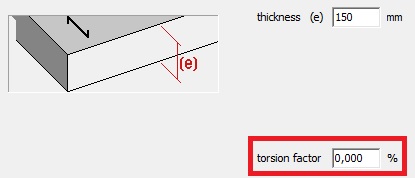 You can take the torsional ridigidy into account by entering a value for the torsion factor. You can take the torsional ridigidy into account by entering a value for the torsion factor. |
By default the torsional rigidity is calculated using a torsion factor of 80%.
You cannot change the torsion factor. |
Notes:
- Both plate types will give similar results, if you set the torsional rigidity for this plate type 80% and adjust the self-weight.
- This plate type
 is not suitable for hollow-core-slabs since the upper and lower ‘flenge’ of the plate bear in two directions while a hollow-core-slab has a one-directional behaviour.
Now which one do I choose?
Well, that depends on what you want to know:
- If you want to view stresses and/or calculate the reinforcement, use .
- If you want to view mean internal forces (like the shear force to check VRd.c), use (in combination with a cut line).
The presence of the torsional rigidity in this plate type, makes it harder to interpret the internal forces. - If you only want to take the stiffness of the plate into account, use .