The goal of this article is to translate the stiffness of a vertical elements (column, wall, surface support) to a spring constant  which can be applied in the Y-direction in Diamonds.
For a column
With Hooke’s Law  and the formula for stress
  , a formula for the spring constant can be deducted. This formula assumes that the element is supported at the buttom.
![\[k=\frac{F}{\Delta x} = \frac{\sigma A}{\Delta x} = \frac{E \varepsilon A}{\Delta x} = \frac{E (\Delta x /l) A}{\Delta x} = \frac{E A}{l}\]](https://support.buildsoft.eu/wp-content/ql-cache/quicklatex.com-21b315f99d603fce98a877dd4e92a640_l3.png "Rendered by QuickLaTeX.com")
with
 the modulus of elasticity of the column
 the cross-section area of the column
 the length of the column
Input
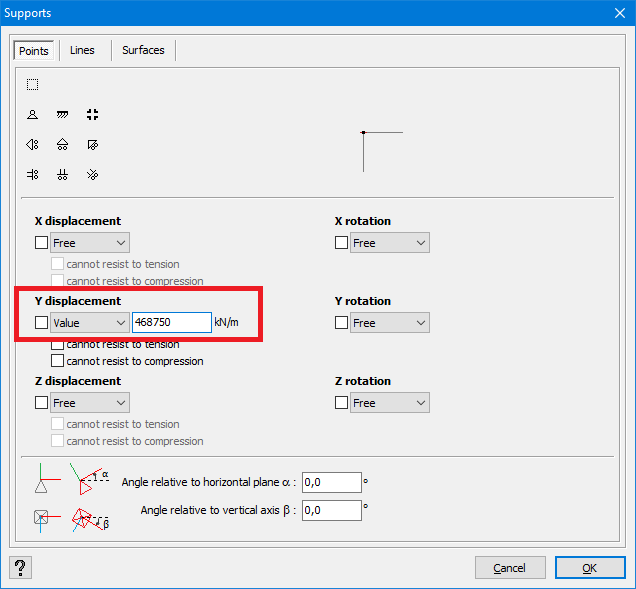
Note: E is in N/mm², b, h and H are in mm; the result is converted to kN/m.
This value must be entered in  :
:
For a foundation pile
In case of a foundation pile, there are two springs in series: the one for the pile  and one for the soil
  .
.
![\[\frac{1}{k}= \frac{1}{k_p} + \frac{1}{k_g}\]](https://support.buildsoft.eu/wp-content/ql-cache/quicklatex.com-6800b7f2e46b12a9cef634aa2db5b868_l3.png "Rendered by QuickLaTeX.com")
If there is no data available on the soil, but you still want to take the effect into account, you could assume that  . The formula for the spring contant becomes:
![\[k= \frac{k_p}{2} = \frac{E A}{2 \cdot l}\]](https://support.buildsoft.eu/wp-content/ql-cache/quicklatex.com-e34dd1be94cd5c19aecd9577615a6ed7_l3.png "Rendered by QuickLaTeX.com")
The "2" is refered to as the stiffenss ratio  in the calculator below.
Input
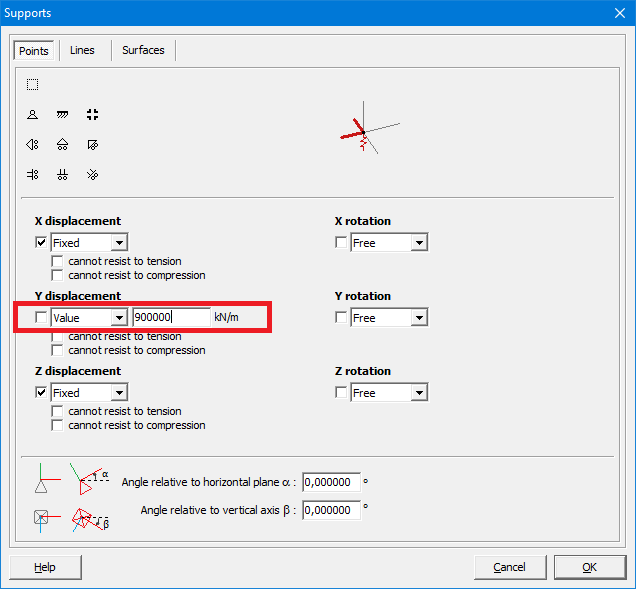
Note: E is in N/mm² and b, h and H are in mm, so (E·b·h)/(s·H) is in N/mm; 1 N/mm = 1 kN/m.
This value must be entered in :
For a wall
Again Hook's law and the formula for stress are used. But since the length the wall will be modelled as a line support, this dimension is no longer in the formula:
![\[k= \frac{E b}{l}\]](https://support.buildsoft.eu/wp-content/ql-cache/quicklatex.com-627967c6d74cca7700d5b2e556ab4923_l3.png "Rendered by QuickLaTeX.com")
with
- the modulus of elasticity of the wall
 the thickness of the wall
- the height of the wall
Input
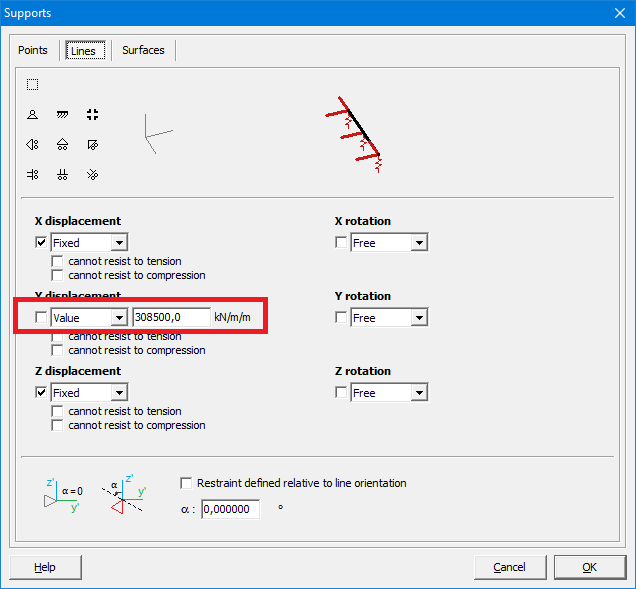
Note: E is in N/mm², b and H are in mm; the result is converted to kN/m².
This value must be entered in :
For a foundation pit (supported area)
Again, there are two springs in series: the one for the pit and one for the soil .
If there is no data available on the soil, but you still want to take the effect into account, you could assume that . Both dimensions of the surface support will be modelled. Which gives this as the formula for the spring constant :
![\[k= \frac{k_p}{2} = \frac{E}{2 \cdot l}\]](https://support.buildsoft.eu/wp-content/ql-cache/quicklatex.com-c0a6f205ffc8845b32789fd0101465d9_l3.png "Rendered by QuickLaTeX.com")
with
- the modulus of elasticity of the surface support
- the height of the pit
- The "2" is refered to as the stiffenss ratio in the calculator below.
Input
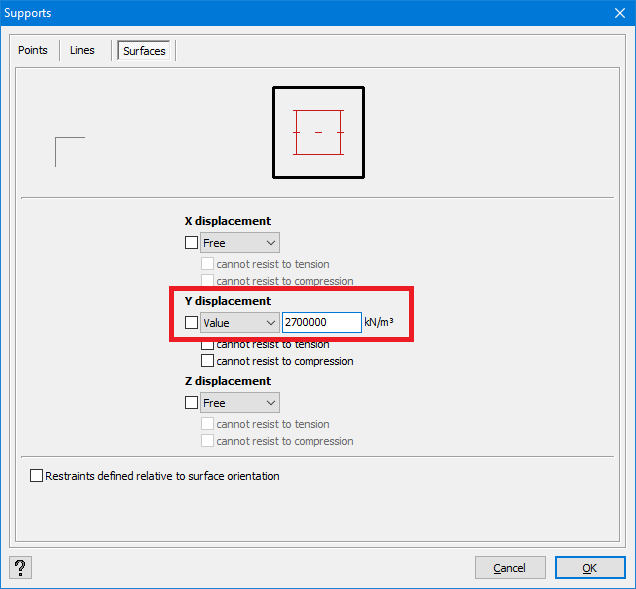
Note: E is in N/mm² and H is in mm; the result is converted to kN/m³.
This value must be entered in :